
A lamp you turn on by touching it
Tap a metal pad and two white LEDs turn on, tap again and they turn off. One flip-flop chip and a MOSFET.
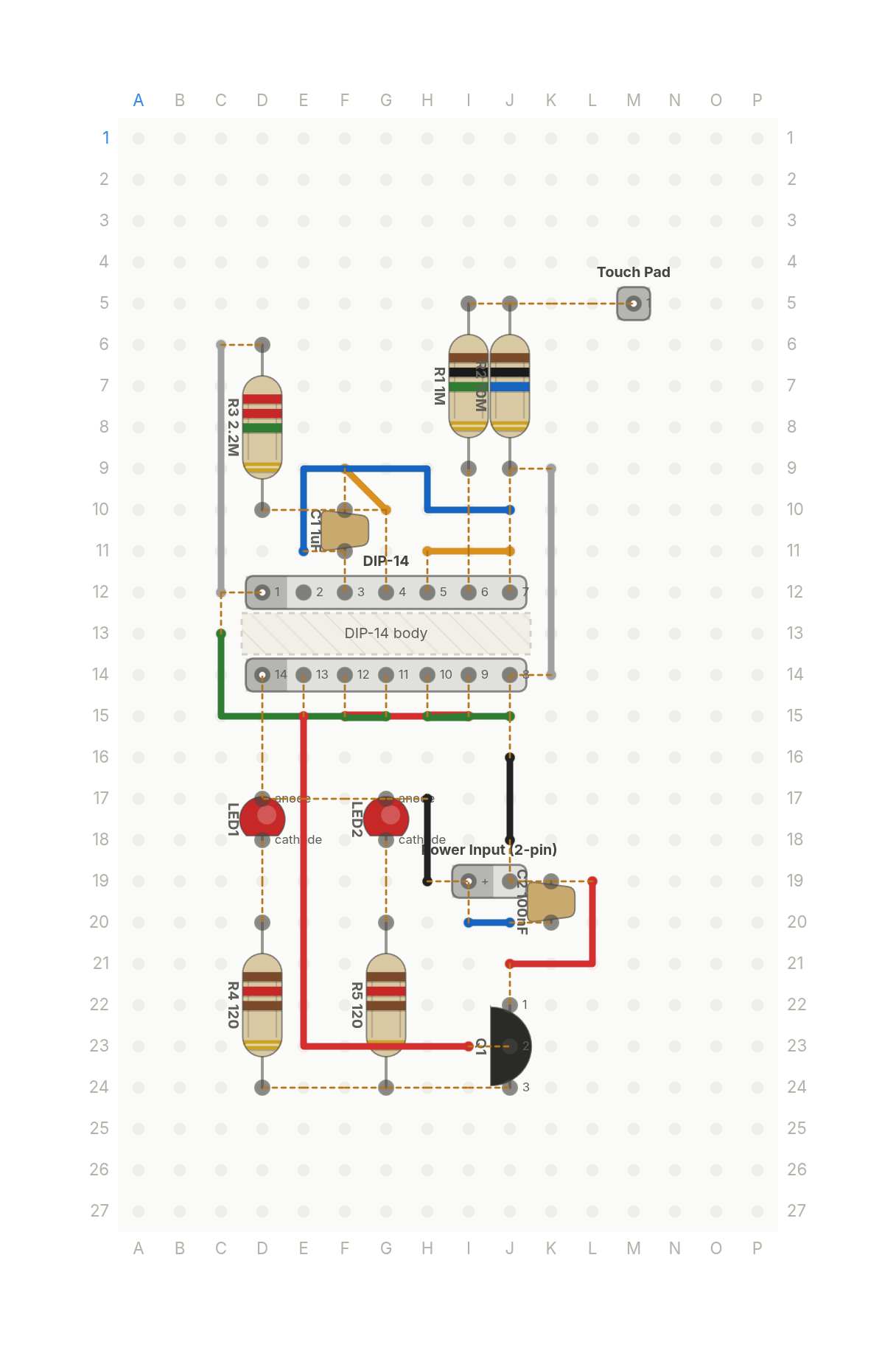
Free build sheet
The parts, every wire with its length and bend points, a bend guide, both sides of the board and checkboxes to track your progress. Print it or keep it open at the bench.
Open the build sheetWhat you need
13 parts on a perfboard 16 × 27 holes, plus hookup wire.
| Qty | Part | Where to buy |
|---|---|---|
| 1 | Ceramic Cap1uF C1 | Buy Ceramic Cap on Amazon |
| 1 | Ceramic Cap100nF C2 | Buy Ceramic Cap on Amazon |
| 1 | Power Input (2-pin) J1 | |
| 2 | LED LED1, LED2 | Buy LED on Amazon |
| 1 | N-ch MOSFET (TO-92) Q1 | Buy N-ch MOSFET (TO-92) on Amazon |
| 1 | Resistor (axial)1M R1 | Buy Resistor (axial) on Amazon |
| 1 | Resistor (axial)10M R2 | Buy Resistor (axial) on Amazon |
| 1 | Resistor (axial)2.2M R3 | Buy Resistor (axial) on Amazon |
| 2 | Resistor (axial)120 R4, R5 | Buy Resistor (axial) on Amazon |
| 1 | Touch Pad U1 | |
| 1 | DIP-14 U2 |
Check every pin against the datasheet of the exact part in your hands before wiring.
As an Amazon Associate I earn from qualifying purchases.
Cut list
13 wires, 268 mm (10.6 in) in total, in the order the build sheet cuts them. Wire numbers match the build sheet. Each length includes 5 mm per end to go through the hole.
| Wire | Colour and net | Length | ||
|---|---|---|---|---|
| 6 | BlackVCC H19 → H17 | H19 → H17 | 15mm | Straight |
| 12 | BlackGND J16 → J18 | J16 → J18 | 15mm | Straight |
| 5 | BlueVCC I20 → J20 | I20 → J20 | 13mm | Straight |
| 11 | BlueGND J10 → E11 | J10 → E11 | 30mm | 10mm (90°), 13mm (90°), 20mm (90°) |
| 10 | GreenGND J15 → H15 | J15 → H15 | 15mm | Straight |
| 4 | GreenPULSE C13 → G15 | C13 → G15 | 25mm | 10mm (90°) |
| 1 | RedTOGGLE F15 → I15 | F15 → I15 | 18mm | Straight |
| 13 | RedGND L19 → J21 | L19 → J21 | 20mm | 10mm (90°) |
| 7 | RedLAMP I23 → E15 | I23 → E15 | 40mm | 15mm (90°) |
| 9 | WhiteGND K9 → K14 | K9 → K14 | 23mm | Straight |
| 3 | WhitePULSE C6 → C12 | C6 → C12 | 25mm | Straight |
| 2 | YellowTIMER F9 → G10 | F9 → G10 | 14mm | Straight |
| 8 | YellowGND J11 → H11 | J11 → H11 | 15mm | Straight |
About this build
A lamp you turn on by touching it, built around one CD4013B dual D flip-flop. A bare touch pad picks up the small mains hum your body carries.
The first flip-flop turns that hum into one clean pulse about a second and a half long, set by a 2.2M resistor and a 1uF capacitor. The pulse clocks the second flip-flop, whose inverted output is wired back to its own data input, so every tap flips it and it stays flipped. Tap the pad, don't hold it: a touch longer than the pulse toggles the lamp again.
The flip-flop output can only source about half a milliamp at 5V, so it drives the gate of a 2N7000 MOSFET, and the MOSFET switches two white LEDs, each with its own 120 ohm resistor. The parts library has no touch pad, so the video draws one first, a square plate on a single pin. Small MOSFETs don't all order their leads the same way, so wire it from the build sheet and the 2N7000 datasheet.
More builds
See all builds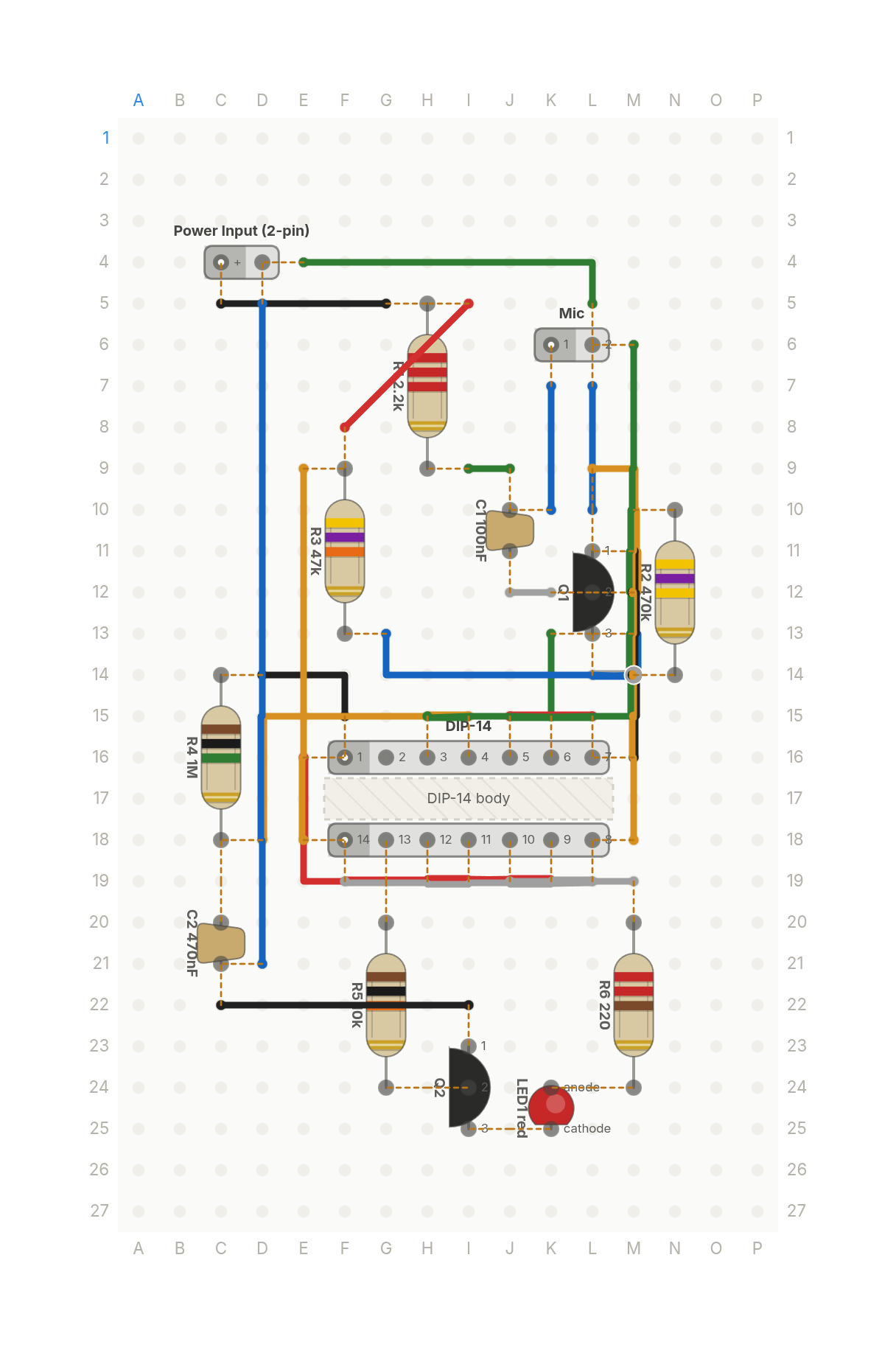 Video
VideoThe Clapper, recreated: lights that turn on when you clap
Clap once and an LED turns on, clap again and it turns off. A microphone, two transistors and one flip-flop chip.
14 parts · 24 wires
SensorsLights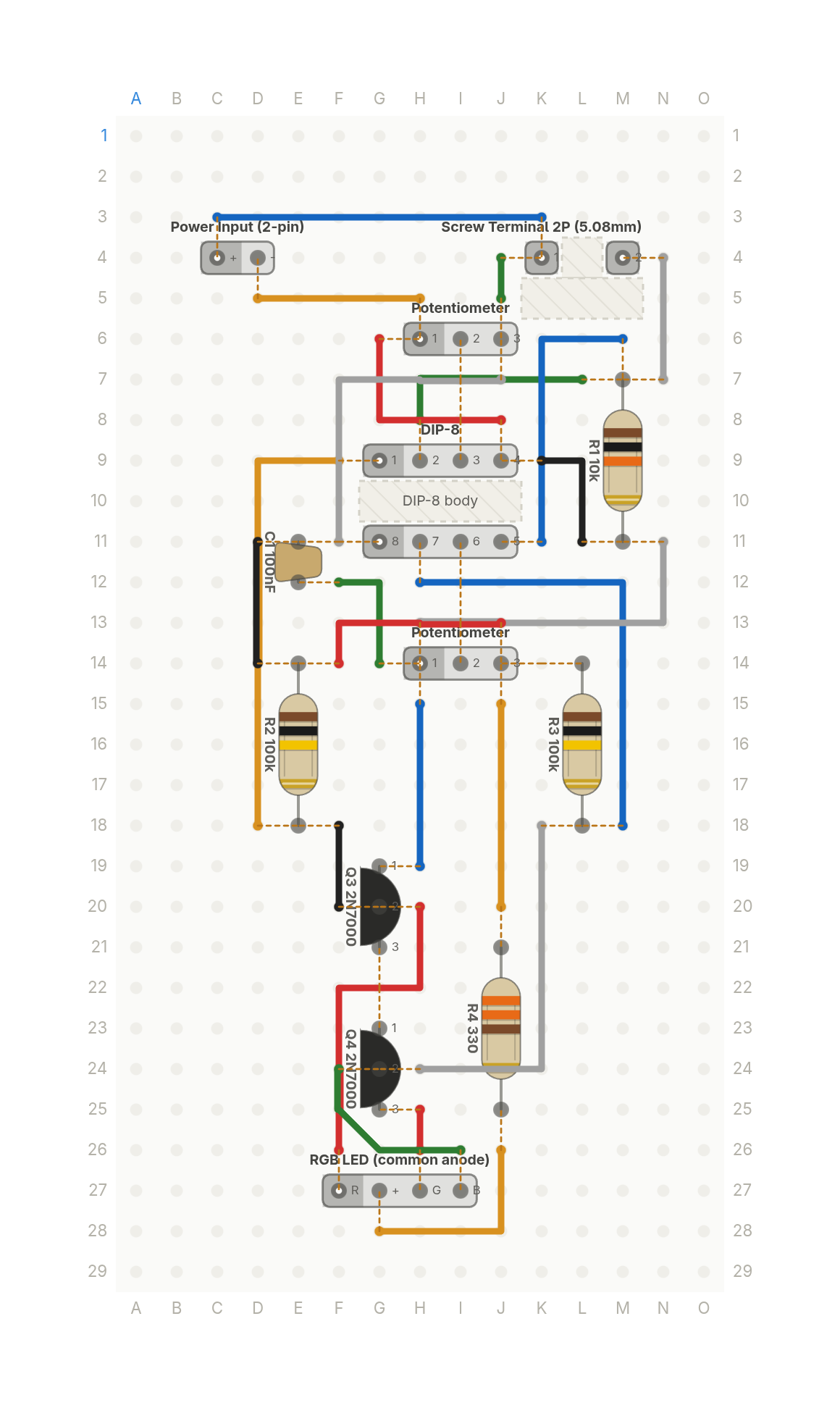 Premieres Oct 13
This LED turns red when the room gets hot
An RGB LED that shows the room temperature: red when it's hot, blue when it's cold, green in between. Two knobs set the limits.
13 parts · 23 wires
SensorsLights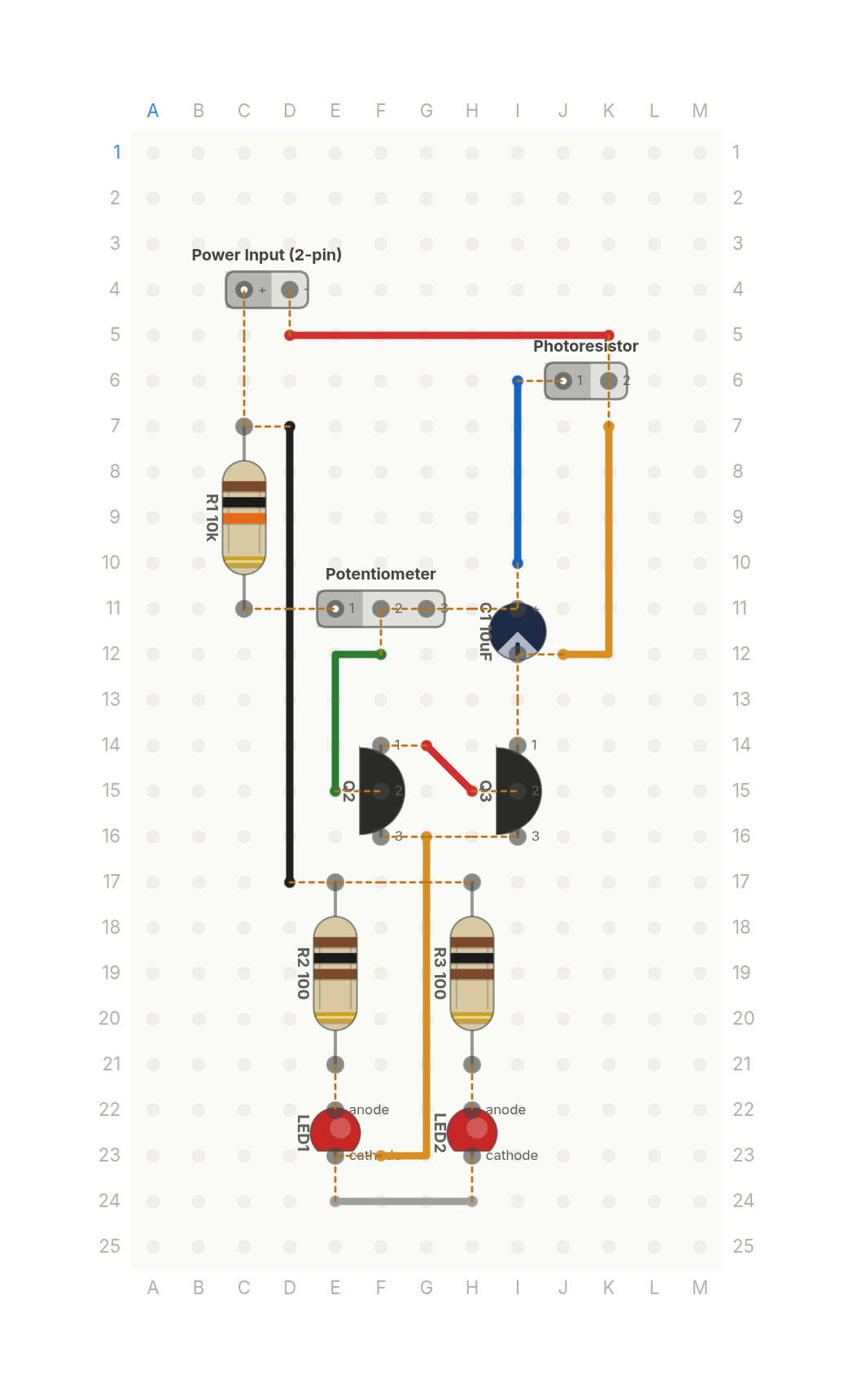 Premieres Oct 26
How does a night light know it's dark?
A night light that switches two LEDs on when the room goes dark. A photoresistor, a trim knob and two transistors.
11 parts · 8 wires
SensorsLights