
Why the most-built circuit gets hot (the math)
A 7805 taking 12V down to 5V, and the one line of math that tells you whether it needs a heatsink.
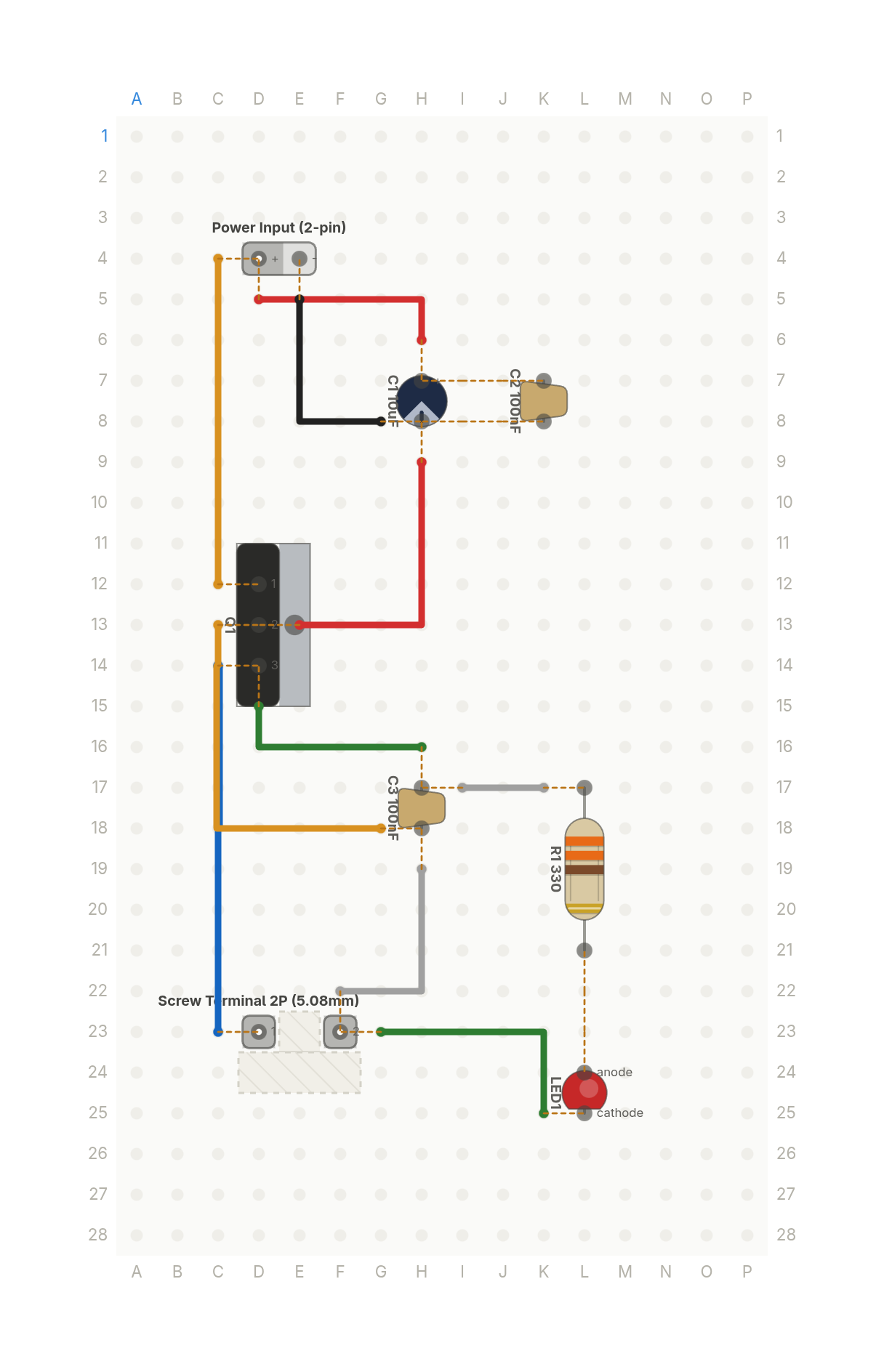
Free build sheet
The parts, every wire with its length and bend points, a bend guide, both sides of the board and checkboxes to track your progress. Print it or keep it open at the bench.
Open the build sheetWhat you need
8 parts on a perfboard 16 × 28 holes, plus hookup wire.
| Qty | Part | Where to buy |
|---|---|---|
| 1 | Electrolytic Cap10uF C1 | Buy Electrolytic Cap on Amazon |
| 2 | Ceramic Cap100nF C2, C3 | Buy Ceramic Cap on Amazon |
| 1 | Power Input (2-pin) J1 | |
| 1 | Screw Terminal 2P (5.08mm) J2 | |
| 1 | LED LED1 | Buy LED on Amazon |
| 1 | TO-220 Q1 | |
| 1 | Resistor (axial)330 R1 | Buy Resistor (axial) on Amazon |
Check every pin against the datasheet of the exact part in your hands before wiring.
As an Amazon Associate I earn from qualifying purchases.
Cut list
10 wires, 255 mm (10.0 in) in total, in the order the build sheet cuts them. Wire numbers match the build sheet. Each length includes 5 mm per end to go through the hole.
| Wire | Colour and net | Length | ||
|---|---|---|---|---|
| 6 | BlackGND E5 → G8 | E5 → G8 | 23mm | 13mm (90°) |
| 5 | Blue5V C14 → C23 | C14 → C23 | 33mm | Straight |
| 4 | Green5V H16 → D15 | H16 → D15 | 23mm | 15mm (90°) |
| 10 | GreenGND G23 → K25 | G23 → K25 | 25mm | 15mm (90°) |
| 1 | Red12V D5 → H6 | D5 → H6 | 23mm | 15mm (90°) |
| 7 | RedGND H9 → E13 | H9 → E13 | 28mm | 15mm (90°) |
| 3 | White5V K17 → I17 | K17 → I17 | 15mm | Straight |
| 9 | WhiteGND H19 → F22 | H19 → F22 | 23mm | 13mm (90°) |
| 2 | Yellow12V C4 → C12 | C4 → C12 | 30mm | Straight |
| 8 | YellowGND C13 → G18 | C13 → G18 | 33mm | 18mm (90°) |
About this build
A 7805 linear regulator taking 12V down to 5V for a 200mA load off the board. The board itself is simple: the regulator, a 10uF and a 100nF on the input, a 100nF on the output, a 330 ohm resistor and a power LED, and a screw terminal that hands the 5V rail out.
The interesting part is the heat. A linear regulator burns the difference between input and output as heat: P = (Vin - Vout) x I, so (12 - 5) x 0.2 = 1.4 W. A bare TO-220 with no heatsink is specified at 65 C/W junction to ambient, which puts the junction about 90 C above the room.
Feed it 7V instead and the same load costs 0.4 W. If you get to pick the input voltage, pick the lowest one that still leaves the regulator its headroom.
More builds
See all builds Video
The regulator every ESP32 secretly needs
A 3.3V supply for an ESP32: an LD1117 regulator with enough capacitance to ride out the radio's current spikes, plus a power LED.
8 parts · 12 wires
Power Video
The circuit inside every relay module
The small circuit inside every hobby relay module: a transistor switch, a base resistor, a flyback diode and a status LED.
7 parts · 9 wires
Power Video
One part saves your board when you plug it in backwards
One P channel MOSFET that passes power with almost no loss when you plug in the right way, and blocks it when you don't.
7 parts · 7 wires
Power